Snow leopard
Panthera uncia
 Vulnerable
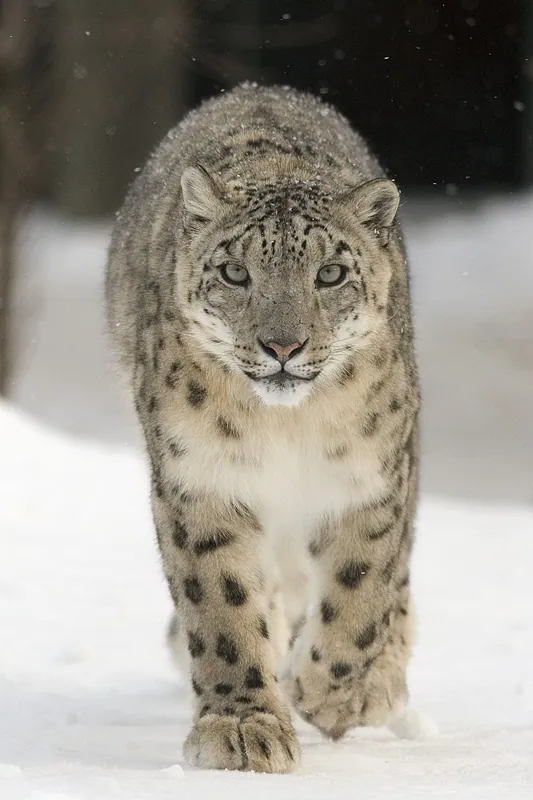
Photo: Bernard Landgraf · CC BY-SA 3.0
The snow leopard is a big cat that prowls the high mountains of Central and South Asia, from Afghanistan to China. It thrives in cold, rocky areas where few other large cats can survive, often above 3,000 meters.
- It lives in some of the highest mountain ranges on Earth.
- Its habitat includes alpine zones up to 4,500 meters in elevation.
- Unlike most big cats, it rarely encounters humans due to its remote home.
Classification and size
The snow leopard (Panthera uncia) belongs to the same genus as the tiger and leopard. Its broad paws, thick coat and unusually long tail are easy to pick out in a photograph. The tail helps the cat balance on broken rock and can wrap around its body when it rests. The pale coat has darker rosettes, which break up its outline among slopes of rock and snow. The cat has a compact build, while the long tail adds a large share of its total length.
Habitat and distribution
Snow leopards inhabit the mountains of Central and South Asia, including the Himalaya and the Tibetan Plateau. Steep slopes, rocky outcrops and ravines give the cats places to rest and cover from which to approach prey. Elevation varies by location. A snow leopard can follow animals onto lower ground in parts of its range, and rocky mountain habitat can be suitable even when it has little snow. Its distribution stretches across national borders, which makes coordination across those borders important.
Diet and behaviour
Wild sheep and goats are important prey. Blue sheep and ibex are examples from different parts of the range. Snow leopards also eat smaller mammals where they are available. A cat can work its way through a ravine or use an outcrop to approach a herd from cover. Snow leopards normally live alone, and researchers often use remote cameras to find them on routes that the cats revisit.
Conservation
The global IUCN category is Vulnerable. Loss of wild prey and killing in response to livestock losses put pressure on the species. People and domestic animals use some of the same mountain country. Conservation work can therefore involve protecting prey and working with herders to reduce losses. Good local records matter because the cats range over rugged country and can be difficult to detect.
Sources
At a glance
- Classification
- Mammal
- Scientific name
- Panthera uncia
- Habitat
- Mountain
- Regions in this directory
- Asia
- Diet
- carnivore
- Relative size
- large
- IUCN Red List
- Vulnerable (VU)


