Jaguar
Panthera onca
 Near threatened
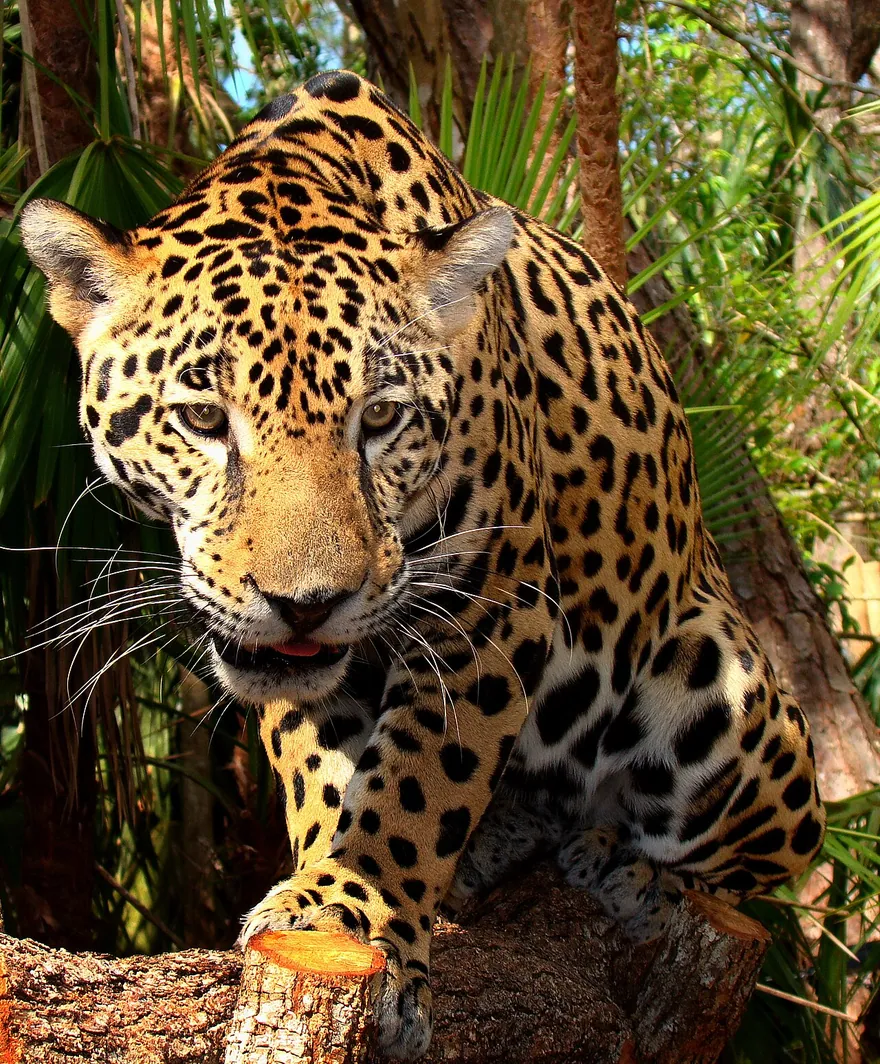
Photo: Bjørn Christian Tørrissen · CC BY-SA 3.0
The jaguar is a large, powerful cat found in the Americas, known for its striking coat of yellow fur with dark rosettes. It thrives in dense forests and wetlands, where its strong jaws allow it to hunt prey with precision.
- Its bite can pierce turtle shells and crush skulls.
- Some jaguars have a rare black coat.
- It can grow up to 1.85 meters in length.
Classification and size
The jaguar (Panthera onca) is the largest living cat native to the Americas. It belongs to the same genus as the leopard and tiger. Its heavy head and stocky build are good clues in a photograph. On many jaguars the flank markings are rosettes with small spots inside them. Body size varies across the range and between sexes, with males generally heavier than females. Dark-coated jaguars are another form of the same species and can retain a visible pattern when the light catches the coat.
Habitat and distribution
Most jaguars live in Central and South America, from Mexico south to Argentina, with the Amazon as a major stronghold. The species uses rainforest, wetlands and seasonally dry areas. The Pantanal is a good example of wetland habitat where waterways are part of a jaguar’s home range. A jaguar is a capable swimmer, so open water can form part of a hunting area. Connected habitat allows young adults to disperse and establish a range of their own.
Diet and hunting
Jaguars eat many kinds of animals. A jaguar in wet country may take capybaras and caimans, while cats elsewhere hunt mammals such as peccaries and deer. Their powerful jaws let them tackle a variety of prey. A jaguar may wait beside a route used by prey or move under cover to get close. Adults generally hunt by themselves. The prey list for a single site depends on which animals live there and how the local habitat changes through the year.
Conservation
The IUCN lists the jaguar as Near Threatened globally. Forest clearing and roads can fragment habitat, and attacks on livestock can lead to retaliatory killing. Smithsonian researchers track movements to see where habitat corridors could keep populations connected. Those paths matter especially where a cat must cross developed land between areas with good cover.
Sources
At a glance
- Classification
- Mammal
- Scientific name
- Panthera onca
- Habitat
- Rainforest, Wetland, Forest
- Regions in this directory
- North America, South America
- Diet
- carnivore
- Relative size
- large
- IUCN Red List
- Near Threatened (NT)


