Leopard
Panthera pardus
 Vulnerable
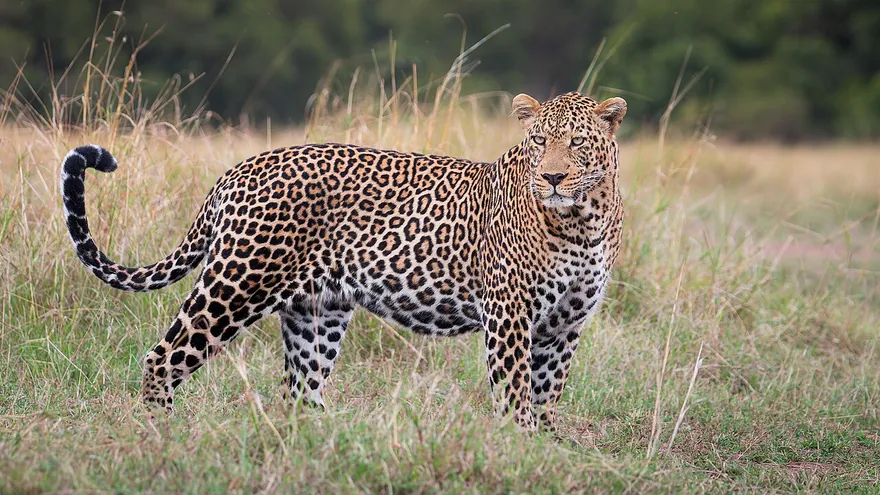
Photo: Sumeet Moghe · CC BY-SA 4.0
The leopard is a powerful wild cat found in Africa and Asia, known for its golden coat dotted with rosette-shaped spots. These stealthy hunters have slender, muscular bodies built for climbing and pouncing.
- Males can weigh up to 72 kg (159 lb), while females are smaller at 43 kg (95 lb) max.
- Their tails stretch 66-102 cm (26-40 in), helping them balance in trees.
- Leopards' shoulder height reaches 60-70 cm (24-28 in), about knee-high on an adult human.
Classification and size
The leopard (Panthera pardus) belongs to the cat family Felidae. Its coat usually has rings of spots called rosettes. Compare them with a jaguar’s, which often have a dot inside. A dark or melanistic leopard can still show its rosettes in good light. Leopards have a long tail and a compact, muscular frame. Adults vary considerably in size across their wide range, and males are generally larger than females. Both the build and the tail suit a cat that regularly climbs.
Habitat and distribution
Leopards live in parts of Africa and Asia. They occupy habitats ranging from savanna and dry country to forest and mountains. What looks like a continuous range on a continent-wide map is often broken into separate populations. Wooded cover can serve as a place to rest, to watch for prey and to escape larger competitors. Leopards also use rocky terrain, where ledges and crevices provide different kinds of cover.
Diet and behaviour
Leopards usually live and hunt alone. Their diet can include small and medium-sized antelope, monkeys, other mammals and birds, depending on the area. In some places a leopard drags a kill up a tree, which makes it harder for ground-dwelling scavengers and larger carnivores to reach. That behaviour depends on what other predators are present and on whether the leopard can move its prey. A sighting of a leopard in a tree can therefore tell you something about its habitat and competitors as well as its climbing ability.
Conservation
The IUCN lists the leopard as Vulnerable worldwide. The loss of habitat and wild prey can bring leopards into more frequent contact with livestock, and illegal killing puts pressure on some populations. A wide geographic range contains local populations with very different risks. Conservation assessments for a particular subspecies can therefore differ from the worldwide species assessment.
Sources
At a glance
- Classification
- Mammal
- Scientific name
- Panthera pardus
- Habitat
- Forest, Savanna, Grassland
- Regions in this directory
- Africa, Asia
- Diet
- carnivore
- Relative size
- large
- IUCN Red List
- Vulnerable (VU)


