Red panda
Ailurus fulgens
 Endangered
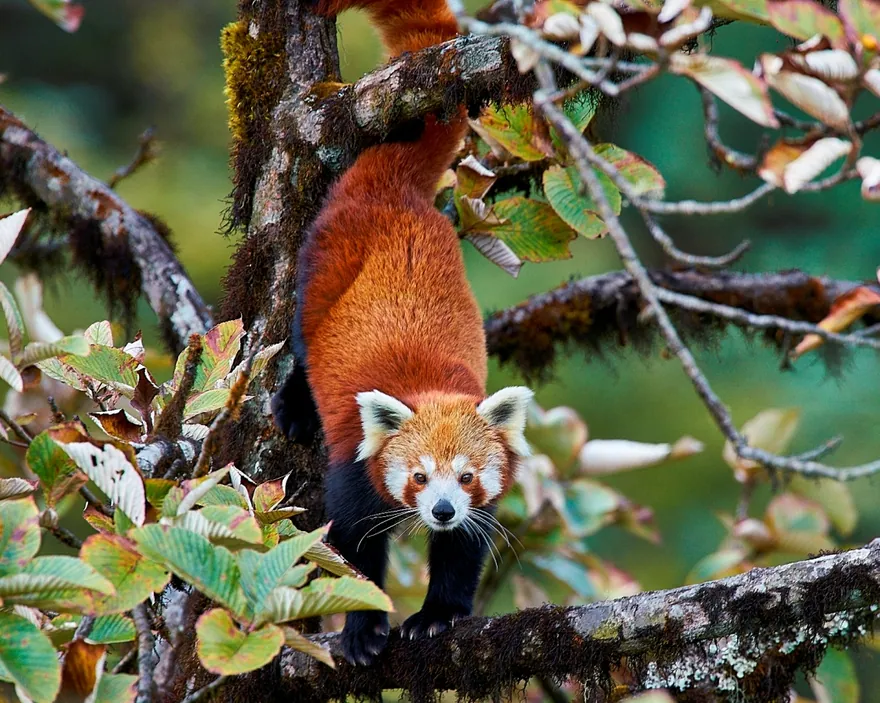
Photo: Ajit Hota · CC BY-SA 4.0
The red panda is a small, tree-dwelling mammal with striking rust-colored fur, black legs, and a bushy ringed tail. It lives in the misty forests of the Himalayas and parts of China. Built for climbing, it moves through the trees with ease thanks to its nimble limbs and sharp, curved claws.
- Its body measures 20 to 25 inches long, with a tail nearly as long.
- Adults weigh between 3.2 and 15 kg, about the size of a house cat.
- Semi-retractable claws and flexible joints help it grip branches tightly.
Classification and size
The red panda (Ailurus fulgens in this directory) belongs to the family Ailuridae. It has russet fur, a pale face with darker markings and a long ringed tail. The Smithsonian National Zoo gives an adult weight range of about 3 to 6 kilograms. The tail helps it balance on branches, and it can curl its tail around itself when resting. A projection of a wrist bone works like an extra thumb and helps the animal grip bamboo stems while feeding.
Habitat and distribution
Red pandas live in mountain forests of the Himalayas and southwestern China. They are associated with cool forest and an understory where bamboo grows. A patch needs both feeding areas and trees that offer rest or shelter. Adults often spend daylight hours resting on branches or in sheltered places and are more active at cooler times. The common name can refer to populations on both sides of parts of this range, and some researchers treat the Himalayan and Chinese forms as separate species.
Diet and behaviour
Bamboo leaves and shoots make up most of a red panda’s diet. Other foods may include fruit, eggs or small animals. An animal can pull a stem closer with a forepaw, strip leaves with its teeth and move on to another plant. Bamboo is relatively low in usable energy, so feeding takes up a substantial part of the day. The giant panda also relies on bamboo and has a wrist adaptation for gripping stems, though it is a bear in a different family.
Conservation
The IUCN assessment recorded here is Endangered. Forest fragmentation can separate patches with the bamboo and trees the animals need. Where a population occupies a small or isolated patch, it can be harder for individuals to move into neighbouring areas. Conservation teams work with communities to protect forest habitat and monitor where red pandas still occur.
Sources
At a glance
- Classification
- Mammal
- Scientific name
- Ailurus fulgens
- Habitat
- Forest, Mountain
- Regions in this directory
- Asia
- Diet
- herbivore
- Relative size
- small
- IUCN Red List
- Endangered (EN)