Okapi
Okapia johnstoni
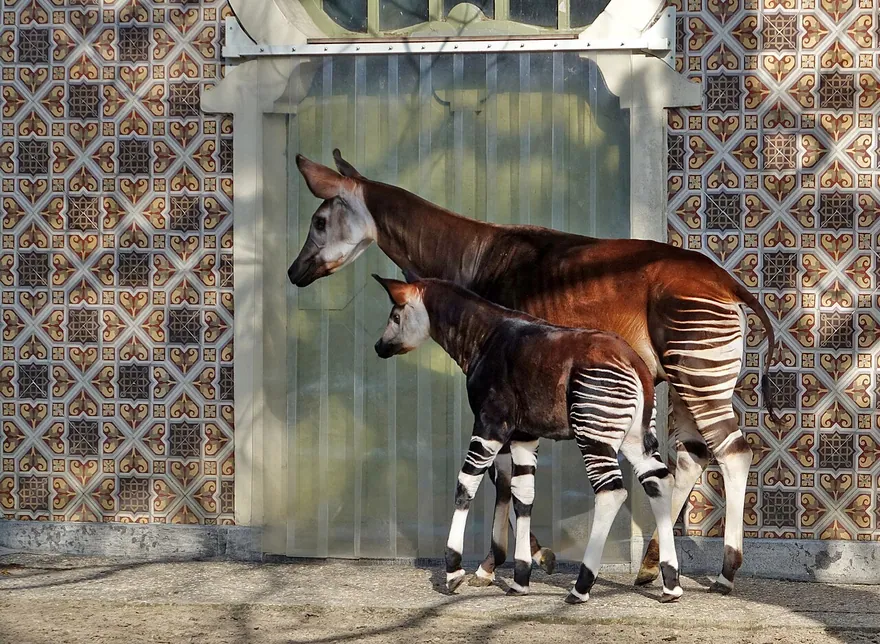 Endangered
Photo: Alan Eng from Brussels, Belgium · CC BY 2.0
The okapi is a shy, striped-legged mammal that lives only in the rainforests of the Democratic Republic of the Congo. Though its zebra-like stripes might trick you, it's actually the giraffe's closest living relative. These forest dwellers are so elusive that scientists only confirmed a second population across the Congo River using genetic clues.
- Its striped back legs resemble a zebra's, but its long neck reveals its giraffe family ties.
- Okapis share their family tree with only one other living species: the giraffe.
- Scientists recently discovered a hidden okapi population using DNA evidence, not direct sightings.
Classification and size
The okapi (Okapia johnstoni) belongs to the giraffe family, Giraffidae. It has a long neck, large ears and striped upper legs and rump. Adult males usually have short skin-covered horns called ossicones. The Okapi Conservation Project gives a typical shoulder height of roughly 1.5 metres. The body is lower to the ground than a giraffe’s, and the dark coat and stripes can make the animal hard to pick out against the light and shade of dense forest.
Habitat and distribution
The okapi is native to the Democratic Republic of the Congo. It lives in the dense forests of the Congo Basin, including the Ituri Forest. In the forest it uses paths and looks for food among understory plants, where visibility is often limited. Its restricted range makes the condition of those forests particularly important. Protected areas such as the Okapi Wildlife Reserve cover some of the habitat, with other populations living elsewhere in the country.
Diet and behaviour
Okapis browse on vegetation, including leaves, buds and shoots. They use a long, mobile tongue to pull foliage from stems. This is a feature they share with giraffes, although an okapi reaches into dense vegetation close to the ground. Adults are usually solitary. They can leave scent on the paths they travel, which helps them communicate in a habitat where they may rarely see one another. An animal’s feeding trail can reveal how it makes use of a forest with many different plants at different heights.
Conservation
The IUCN lists the okapi as Endangered. Forest loss and degradation, poaching and snares are among the threats. The animal is difficult to observe directly in dense forest. Surveying signs along trails and using remote cameras can help conservation teams learn which areas are still used.
Sources
At a glance
- Classification
- Mammal
- Scientific name
- Okapia johnstoni
- Habitat
- Rainforest
- Regions in this directory
- Africa
- Diet
- herbivore
- Relative size
- large
- IUCN Red List
- Endangered (EN)